
Teaching English in Russia - An Easy Way to Settle for a Long-Term
English Teaching in General
 |
|
|
photo by Sasha Reshetilov
|
So, how to narrow it down? Well let's begin by debunking some myths. The first is that you need a recognized TEFL qualification. If you're not a native speaker of English, then there's almost no way to obtain work teaching it without one of these. As a native speaker, it's definitely possible to make a living in the field unqualified, albeit with far more limitations, including the amount of money you're likely to make. The questions you should ask yourself are, "How much do I really know about teaching?" and "How much do I really know about the English language?" Sure, you can speak it well, but do you know a Present Perfect from a 2nd Conditional? Russian students LOVE grammar.
Teaching English in Russia
English is the new "black" here in Russia (although black is unlikely to go anywhere anytime soon). Despite most people having studied it at school for 5 years, and many going on to learn it at college or university, the level of teaching at these stages is poor, as is the students' motivation. Once in the workforce, they begin to wish they'd paid more attention to their English studies, and that's where the adult education process begins. People are also recognizing how important it is for their children to learn, and there is an equally large demand for teaching children of all ages.
For some ridiculous reason, an "hour" in teaching is equal to 45 minutes, so the hours quoted here are based on this figure [the reason is that the Russian universities practice so-called "Academic" hour, which is the length of a lecture or a seminar – 45 minutes - WTR]. They are also only for "face time" (time in front of a class) and do not include preparation or travel time, so consider these when weighing your options.
Language teaching for native speakers can be divided into several categories. Let's examine them in turn.
Language Schools in Russia
The most popular, and probably the easiest to access, is the language school. Most offer only English, but some also teach other languages. They teach all comers,
|
|
Photo by Sasha Reshetilov
|
|
from children to adults ш anyone who will pay. Large international organizations such as BKC International House and EF English First have been established here for many years, as has another locally-established but foreign-owned school, Language Link. There are numerous other more-recent arrivals on the scene, such as Tom's House, Denis' School and Windsor. The larger schools also offer teacher training (which you pay for), and all offer contract and casual positions. A full-time position will see you teaching around 30 hours per week. [Check this topic on "dishonest" English schools on Way to Russia forum, which has lots of first-hand advice and experience]
The contract packages vary depending on experience and qualifications, but are, on balance, much the same. Some, like BKC and Language Link, offer a monthly salary plus share accommodation. An included apartment, even if not centrally located, can be a real advantage, especially as a newcomer to Moscow. Rental accommodation is at a premium, and prices are skyrocketing. Other schools, such as EF, offer a salary plus accommodation allowance. If you manage to find somewhere cheap to live, you can pocket the difference. Either way, the basic salary is enough to survive on, but you definitely have to budget well.
Something that all of these schools have in common is a reputation for a kind of "churn and burn" approach. For those new to the profession, they are a good way to experience Moscow and get some valuable experience at the same time. However, employees are not the most important element in their eyes, so you may be shuffled around to different school locations, and in some cases, may not be paid on time. If you manage to survive the first 9-month contract though, a renewed contract can be somewhat more lucrative. Several teachers I know at BKC re-signed for another tour of duty this year (although several have since moved on to better-paid positions elsewhere). The basic salary for a first-year teacher averages around US$650, plus housing and perks (see below for extras).
Teaching English for Business Clients in Russia
This is a booming sector of the market at present, as Russian businesses realise the value of English-speaking staff in an increasingly international economy. Teaching qualifications are pretty much mandatory in this area, but most important are a professional approach and the demonstrated ability to relate to the clients' business activities. The teaching is almost entirely at the clients' offices, and mostly involves early starts and late finishes (to accommodate the students' work schedules), with long breaks during the day. Due to the travel involved, a full-time contract will usually run at 24 hours a week. Competitive packages, whether including or not including accommodation, total around $US1500.
There seems to be a new entry to this market each month, and most of the language schools also offer this kind of teaching. Others have no classrooms at all, just an office in which to access books and administrative resources. One such company, IPT, began full-time operations in only March this year, and now has 9 contract employees and numerous freelancers, which represents incredibly rapid growth. They're still recruiting, which is an indication that the sector is only growing. In fact, IPT are so keen for native speakers that they're offering a finder's fee for teachers who introduce other teachers whom they employ. Another company, Denis' School, is having their freelancers (see section below) virtually dictate their own hourly rates, the demand is so strong.
"In-company" teaching, as it's known, is good for those who don't want to teach children, and who want to broaden their own business experience. Daryl, a Canadian who has also taught in Slovakia, says he enjoys the formal approach of in-company, although he's not fond of wearing a tie, and the travelling gets to him occasionally.
The lack of a classrooms and the off-site nature of the job usually means little or no interaction with other teachers. Most people find the school atmosphere better for their social lives.
Teaching English at a School
As opposed to language school teaching, this is working exclusively with children. Several private schools are eager to offer English with a native speaker on their curriculum, although it may be more difficult to obtain a job in this sector unless you have a recognised teaching qualification (not just in English language) and at least a year's experience, and they often require references about your experience in working with children.
The private schools can be Russian-only, or mixed (catering for the children of expats
|
|

photo by Sasha Reshetilov
|
|
and wealthy Russians), the latter including The British International School and The Anglo American School (catchy names, huh?). Vanessa, from the Montessori School, whose previous teaching experience was at technical college (adults) in Australia, now earns "excellent money" (she declined to give a figure) teaching 4 to 6 year-olds. She has a Russian assistant in the class to help when the language issue emerges (and with toilet duties). Vanessa (47) finds it tiring but rewarding work.
Damien, a 26 year old American, recently moved from BKC to teaching in a school and says he can't believe he waited so long to jump ship. He now earns around $3000 plus accommodation. Although he lives outside of Moscow, he keeps an apartment in the city for weekends.
Clearly, apart from the qualifications and references required, this kind of teaching is not for everyone. Remember how you were as a school pupil and think if you would like to face yourself in a class!
Freelancing and Private English Teaching in Russia
Most, if not all, teachers here try to supplement their incomes by taking private students. Word of mouth is the best way to obtain them, and discretion is required, especially if you've poached them from your employer! Finding a compatible schedule can be an issue, but cutting out the middle-man can see your hourly rate more than double. Most native speakers manage around $30 per hour for private lessons, but again, rates can vary according to experience and how wealthy your student is. You can also build some rewarding relationships with your students, and get a better overall experience of Russians. Some teachers have managed to go on vacations with their clients. Others dine at fine restaurants (this is one my favourite things) or are treated to outings and invited to Dachas (country houses) for a weekend ш all courtesy of the client, who benefits from pretty solid English conversation practice in your presence.
A more reliable way to access students off-contract is freelancing for schools. The hourly rate is somewhere closer to $15 an hour, and you'll probably teach at a business rather than a home, which may be easier to get to. This rate can go substantially higher, however, after you've developed a relationship with the school you work for. Your reliability and feedback from students can see you move towards $20-$25. There are rare cases of even higher corporate rates, but you must remember that the school finds the client for you, and has administrative costs, so don't push them too hard – if their bottom line drops too much, they may look elsewhere for staff.
Whilst it can be financially beneficial to go solo, there are risks and expenses that some teachers find daunting. For starters, you have to organise and pay for your own visa and registration, find your own accommodation etc. You also risk not being paid for cancellations, and earn nothing for holidays, so you have to budget and save for a snowy day. The good thing is that you can schedule the hours you want to a certain extent, eg all mornings or all evenings, depending on your lifestyle and preferences. Jane (England) and Ben (Australia) earn up to $3500 in a good month, but this requires self-discipline, good scheduling skills and appropriate relationship skills, both with students and schools. It's also very tiring! January could see your income drop to $1000 when you factor in the holidays, so be careful not to take a super-expensive apartment.
Starting and Finishing a Contract
The first couple of months can be tricky in budgetary terms: having paid to get here and for your visa, you then have to work out how much it really costs to live here, and get used to relative costs (i.e. some things will be cheaper than home, some more expensive). US Dollars are still the most commonly quoted rates here, meaning that when the dollar goes down against the Ruble, you're losing money, although it helps with rent, which is also usually in dollars.
In the majority of cases, the real rewards come at the end of a contract, when the last month's salary, plus flight reimbursement and visa costs are paid. Some even offer a bonus amount for successful completion of a contract. Most schools or private employers (for nannies) will arrange and pay for your invitation and visa, although some will merely reimburse you for it. Most will also help you locate accommodation if they don't include it in your package. They are used to dealing with foreign teachers and their settling-in issues.
The Students
As with students of any kind all over the world, some are motivated and some are not. Some are gifted and some are not. Some do their homework and some do not. In general, however, Russian students are pretty good to teach. Most people place a high value on education here, if not only for the commercial opportunities it presents, but purely for pride.
Some children and teens can be difficult, but most recognize that their parents are paying and that they will benefit from having another language. Adults in language schools are usually the ones paying, and so take their studies fairly seriously. Attendance is also good overall in schools.
Business people are often very conscientious, but also very busy, so may not have time to do any work outside of the classroom, making progress slow. Occasionally you will find a student who is being forced to attend lessons by his/her employer, and really doesnХt want to be there, but this is rare in my experience. The other drawback to teaching business students is their unreliability ш lessons are frequently cancelled or poorly attended, simply because their work commitments come first. Don't take it personally.
One aspect that can be a challenge is stopping the students from speaking Russian, even at higher levels. Many times have I had to explain the science behind speaking only the target language in class, draw on my experiences in multi-lingual classes elsewhere (in which they have no choice), and remind them that theyХre paying to be with a native speaker. On the other hand, you can learn a lot about the culture and mentality of Russians, good and bad. Be prepared for some shocks regarding racism, sexism and who invented the radio! Remember, youХre not in Kansas anymore.
As for nannies, well, it's complete lottery. You can get a spoiled brat or an angel. Most of the rich children (i.e. the ones you're likely to be with) tend to be indulged, but can still turn out to be endearing.
You may also be interested in reading the interviews with people who study and teach English in Moscow.
Overall
The kind of teaching you elect to do and the organisation you choose to work for
|
|
|
 |
really depends on what you're looking for. Are you coming to make money, to have fun, to develop your teaching resume, or some other motivation? The first step is to choose the style of teaching (and the age groups), and then find the businesses involved in it. Applying directly has always brought rewards for me: don't be afraid to simply send your CV with a cover email, but be prepared to follow it up with a phone call.
From my point of view, and that of several others I've spoken to, having a TEFL qualification is a definite advantage, if only so you don't look like a dummy when you get into the classroom. It also helps with the pay scale and the range of opportunities.
As I mentioned earlier, there's no shortage of work here, so it pays to be choosy. See if you can get a current or former staff member to give you a reference for a school, and check out some blogs or forums to see if any school has been given a bad write up [you may find this topic about "dishonest" English schools on Way to Russia forum interesting].
Above all, don't ignore the students (the customers), but try to have fun while you're here.
(PS Some of the names in this article have been changed in order to protect the guilty.)
Students
 |
|
|
 |
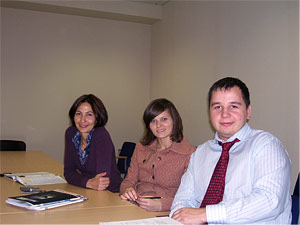
Question: "What do you expect from a good English teacher?"
Semyon: Native speaker who know how to explain grammar.
Irina: Someone who can use different methodologies in lessons, for example music or articles.
Alexei: He must be patient and confident.
Question: "How much are you willing to pay for a lesson?"
Students declined to answer this question, on the basis that it could compromise their ability to negotiate lesson prices. All said they would pay a lot more for a native speaker. I have heard prices ranging from 500-2500RUR ($20 - $100 US) per hour.
Question: "How do you usually find English lessons in Moscow?"
Elena: Foreign teachers usually more fun than Russian teachers. I have more practice when I start dating my teacher!
Arkady: Sometimes I learn that what my Russian teacher told me is wrong. Is better to have native speaker, but sometimes I don't understand her when she speaks quickly.
Tatyana: Sometimes it is difficult to speak in front of native speaker because I am nervous, but if the lesson is interesting, I forget I am nervous.
Teachers
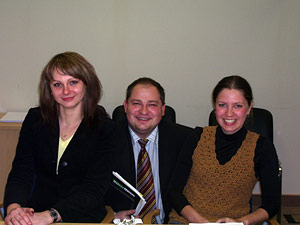
Question: "How do you find teaching experience in Russia?"
Matt: The students are generally great. The schools are sometimes difficult to deal with.
Dave: If you can put up with your school, the students can be a real laugh.
Jane: Teenagers are the same everywhere ш sometimes you want to strangle them, and sometimes they just make you laugh. You need to keep your sense of humour.
Question: "What do you think is the best way to start as a language teacher here?"
Matt: Having a contract is reassuring. Some people won't work without one, but I know others who won't work on contract. I think they all agree that starting with one gives you security.
Dave: The big schools don't pay much, but they give you a good social network and introduction to the place.
Jane: If you're not here to make a fortune, a language school can be fun and good experience.
Question: "How are Russian students different to students in other countries?"
|
|
 |
|
Matt: We're not supposed to date students, but the women in this country...
Dave: More opinionated and likely to say something offensive or ignorant, like the radio was invented by a Russian.
Jane: Both sexes can be sexist, which can make it hard to concentrate sometimes. They can appear quite cold at first, but after a while they can become very close to you. Kind of the opposite to, say, East Asian students, who are polite from the start, but never really let you get close to them.
Relevant Way to Russia Articles
Interviews with Teachers and Students
Discussion of Russian language schools on Way to Russia Talk Lounge Forum
Language Schools in Moscow - Contact Information
BKC International House www.bkcih-moscow.com
EF English First www.englishfirst.com
Language Link www.languagelink.ru
TomХs House www.tomshouse.ru/moscow.pl
DenisХ School www.dschool.ru
Windsor www.windsor.ru/eng/
IPT www.iptrussia.com
Ms Poppins www.mspoppins.com
Angelika (email) angelique_@inbox.ru
The British International School www.bismoscow.com
The Anglo American School www.aas.ru
Montessori www.montessorimagazine.com/jobs-page.html
Some Useful EFL Websites
Dave's ESL Cafe: jobs, blogs and resources. www.eslcafe.com
Just for Jobs: www.tefl.com, www.eslemployment.com, www.jobs.edufind.com
For some "war stories", amusement and some tips: www.englishteacherx.com
Most Recent Articles:

Russian Tax Legislation

Personal legalization of foreign employees in Russia.