
What is a Russian Visa
Step 1: What Is a Russian Visa
A Russian visa looks like this:
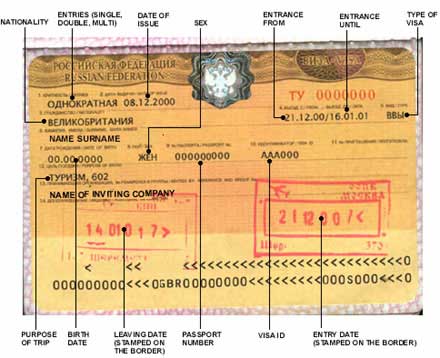
Since October 2019 it is also possible to get a Russian e-visa, which is only valid for some territories for the maximum duration of 8 days. This visa does not get glued into your passport, rather, it's a PDF document, which you present at the border and it's free. You also don't need a visa support letter for this type of visa (standard visas require the visa support letter). EU citizens (except for UK nationals) can get the Russian e-visa if they travel to St. Petersburg or Kaliningrad region, while the citizens of Japan and some Asian countries can get the e-visa to travel to the Far East, including Vladivostok, Kamchatka and Sakhalin. Read more in our guide on how to apply for an e-visa to Russia.
Generally, there are six types of Russian visas: 1) a tourist visa, 2) a business visa, 3) a student visa, 4) a personal (private) visa, 5) a transit visa, 6) work visa. Each visa type corresponds to the purpose of your visit.
However, many people come for a short business trip with tourist visas, or to visit their friends with business visas. So, when choosing the type of visa, the only consideration should be — price / speed of processing / period of stay / the number of entries, and not the formal name of the visa.
Generally, the best options in terms of price, processing speed and flexibility are tourist and business visas. It's better to get a tourist visa if you plan to stay in Russia no longer than one month, and need a single- or a double-entry only. It's better to get a business visa if you plan to stay in Russia longer than 1 month and / or need a multiple-entry visa.
It is easier to obtain a tourist visa, because a business visa costs more, and takes longer to process, although it may save you time and money if you are going to visit Russia several times during 1 year.
You can read more about different types of visas in Types of Visas and Invitations section.
Step 2: How and Where to Get a Russian Visa
The originals of the visa support (invitation) documents are only required if you're applying for a multiple-entry or if you're applying in one of the following countries: Switzerland, Sweden, and sometimes Australia, Japan, and Germany.
Apply for a Russian Visa Online
Step 3: What is the Invitation and How to Get It:
All the required documents that are listed above are easy to get and you should already have them available. The only document that you don't already have is the invitation.
The invitation (also called visa support or tourist confirmation and tourist voucher) is a special document issued by the party that invites you to Russia. The invitation is required by a Russian consulate to be able to process your visa. For every type of visa, there exists a different type of invitation (tourist, business, private, student). For example, to apply for a tourist visa, you'll need a tourist invitation (a tourist visa support). A tourist invitation (or visa support) looks something like this (though it may look different as well):
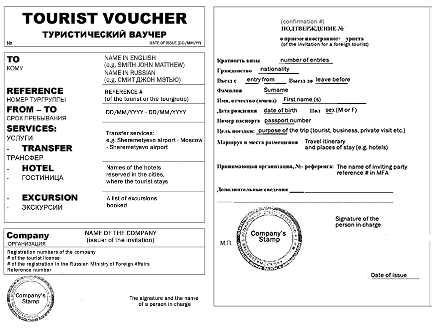
The invitation (visa support) can be issued by a Russian travel agency or by a company or organisation authorized by the Russian Ministry of Foreign Affairs (MFA).
Important: According to the Russian law regulating the status of foreign citizens in Russia (effective 1 Nov 2002), all the functions of visa support authorization will gradually pass from MFA to the Russian Interior Ministry (RIM). If doesn't affect you as a traveler, however, you may expect a slight change in visa support (invitation) processing time and costs.
After you receive the invitation, you can bring it along with the other documents needed (see a comprehensive list of the documents needed for every type of visa at How to Apply section) to the consulate and apply for your Russian visa. It's always better to ask the Russian consulate first whether they accept copies of invitations or only originals and to specify it when applying for an invitation to facilitate processing.
A tourist invitation is needed to get a tourist visa. The tourist invitation comprises two papers: tourist confirmation and tourist voucher. It usually costs about $30 US and takes from 1 hour to 1 day to be issued. Usually, a copy of the invitation is acceptable to the consulate (a fax, a printed out scanned copy), but sometimes they require originals (can be sent by post). When you receive this invitation, you can take it along with the other documents (see Step 2) to the consulate and apply for your Russian visa.
A business invitation is more expensive, because it requires some fees to be paid to the Russian Interior Ministry and takes longer to issue. At the same time, a business visa, that can be obtained with this type of invitation, allows a longer stay (up to 12 months) and multiple entries (which is not possible with a tourist visa). With a business visa, a foreigner can continiously stay in Russia for not longer than 90 days within a 180-day period (new law implemented in October 2007).
The price of a business invitation to obtain a visa for a 3 months stay, double-entry would cost about $90 US. This invitation can be either sent to you by fax or e-mail (if the consulate accepts copies), posted (if the consulate requires originals), or sent by telex directly to the consulate (the most convenient option for you, because you just need to bring your passport, photos, application form and a fee, but also slightly more expensive).
If you need to stay longer than 90 days, your only option is to get separate 3-month business visas and leave Russia every 3 month to reapply for a new visa. You can also get a work permit in Russia and apply for a special work visa. This can only be done if you get an official employment contract in Russia with a company that has quotas to employ foreigners. Finally, you can find a language school or a university in Russia and become a student there, student visas allow longer stays.
If you got your visa support documents through a local travel agency (in your country), the Russian consulate may require a cover letter containing your name, dates and points of arrival / departure in Russia, your itinerary, travel agency reference number -- that is the same information as in the invitation. This letter will NOT be required if you get your visa support through a Russian travel agency, including the ones advertised on this site.
The consulates in Japan and Australia may still require the cover letter, in this case it should be provided to you for free. However, you should try to apply first without it and only get the letter if the consulate asks you to provide it.
You can read more about various types of invitations, that are available in the Types of Visas and Invitations section of this site.
You can apply for a tourist or a business invitation (Russian visa support) online through our site at Services / Visa Support (the service is provided not by WayToRussia.Net, but by our advertisers). The invitation includes all the papers needed to apply for the visa: a tourist confirmation and a tourist voucher. Also, the cover letter (or itinerary) is available for free upon request (only if the consulate requires it after the documents are submitted - usually it's not needed).
Get your Russian Visa Support Online
Step 4: So, How Long and How Much Will It Take?
First of all, you should get an invitation ready. After it's done, you can take the invitation to the Russian consulate along with other documents needed (see How to Apply for a comprehensive list of documents needed for every type of the visa) and a visa application form.
The Russian consulate will accept your papers, charge a visa processing fee, and issue your visa in 1 to 14 days (depends on how much you pay). So, the total processing time will be about 1 day to apply and receive an invitation + about 1 day to submit the documents to the Russian consulate + average 7 days for visa processing = about 9 days. The total visa expenses will be about $30 US for the invitation paid to a travel agency (for a tourist visa) + about $50 US for visa processing paid to the Russian consulate = $80 US.
Step 5: Migration Card:
As of 25 November 2002, all foreigners are obliged to fill in a migration card, which will be given to them the instant they cross the Russian border. It is required to put in the migration card: 1) personal information, 2) terms of stay in Russia and the purposes of the visit and 3) the prospective residential address. It is obligatory to fill in the name of the inviting company and the address of the inviting company (all this should be provided in your visa support paper -- write it down!). The card should be handed over to immigration officials on the border when leaving the country.
The migration card is not something complicated, it's just another paper to fill in and is similar to the "landing card" given to non EU citizens when they fly to Europe. You can see a sample of how the migration card looks and English translation here: MS Word format or Acrobat PDF format. Don't fill it in, because all the cards have a unique number!
Foreign visitors will also be asked how long they intend to spend in Russia – and may be asked to show a proof – return tickets, for example. Their migration card will then be stamped with a specific departure date – according to this information! Even if the visa is valid for a full 30 days, for example, but the migration card was issued for only 25 days, that person will need to leave Russia IN 25 DAYS or before the date on his or her migration card.
The "early interview" is going to be extremely important and may very well determine if the person is even admitted to visit Russia. However, most of the foreigners are admitted without any problems, if their answers match with the information in the visa and visa support documents.
Step 6: Russian Visa Registration:
Your visa must be registred within 7 working days upon your arrival to any Russian city excluding weekend and holidays. The registration should be done by the hotel you're staying in. If you're not staying in a hotel, the landlord of the apartment where you're staying should provide the registation for you.
In order to register your visa, the hotel or your landlord should fill out a special registration form (see a sample in our downloads section) and submit it to the immigration authorities along with a small fee (usually about 150-200R = $6 to 8 US). They have to do it in person via a post office or directly at the local immigration office, which means at least an hour of queuing. That's why most of them charge a little bit extra for it. Hotels usually do the registration for free, though.
Once the form is submitted, you get a special paper from the immigration authorities that the form has been submitted. You have to carry it with you all the time to avoid being fined. If you don't register your visa or fail to show a proof that it has been registered, you might face a fine of $30 US and possible deportation (although the latter is unheard of).
When you leave the country, the hotel or the landlord must notify authorities that you left the country (by sending the second part of the form). If they fail to do it, they might face a fine and you might not be able to enter Russia again. So make sure they do it.
You can read more about Russian visa registration here.
What's Next?
Also Read:
Most Recent Articles:

How to Get a Russian Visa: Step by Step Guide

Russian Visa Application Form
