The most popular online travel guide to Russia, since 2001.
guest
 

Practical Advices for Trans-Siberian Travelers


content: train specifics - tips & safety - hop off / hop on secrets

Trans-Siberian Train Specifics:
Types of Trains:
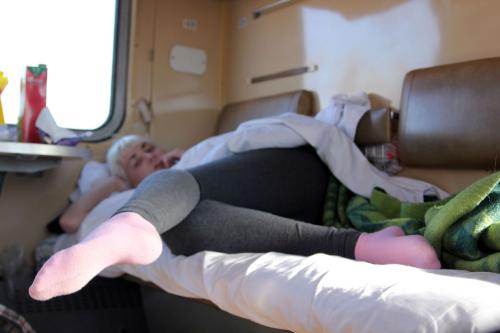
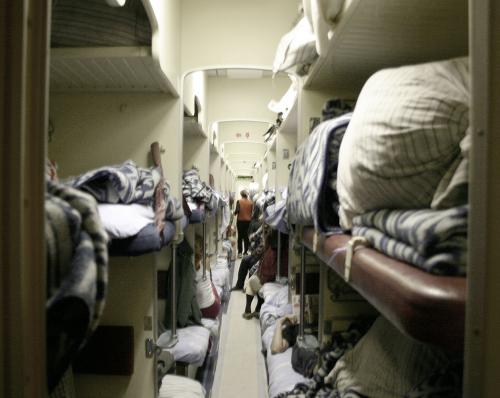
There are 3 classes of trains in Russia: 1st class – 2-berth compartment, either one berth over the other berth placement, or one berth opposite the other one (this is called "spalny vagon" or "sleeping compartment"); 2nd class – 4-berth compartment (there's quite plenty of space, comparing to European trains, it's called "coupe" in Russian); 3rd class – no compartments, just many berths in a car ("platzcart").
There are no 3rd class carriages in the trains which are going along the routes: Moscow - Vladivostok, Moscow - Ulan-Bataar, and Moscow - Beijing, so if you want the 3rd class train, you can only take trains that go between Russian cities. Note, it's hard to buy the 1st class ticket in the summer (most of the tickets are reserved for travel agencies and Chinese embassy).
Luggage: There is plenty of space to keep your luggage in the compartment, either in an overhead luggage storage area, or under a bed. We advise you to keep it under your bed, then if somebody wants to steal your stuff he'll have to get you out of the bed to take your luggage. It's your right to have luggage under your bed: if it's already filled you can ask people to clean it up a bit or call a conductor.
In the trains that circulate between Russia and China (#3, #4, #19, #20), there are many sellers traveling, and they always have a lot of bulky bags. So, if you're taking such a train, we advise you to get there at least 1 hour before departure, so you can get your space.
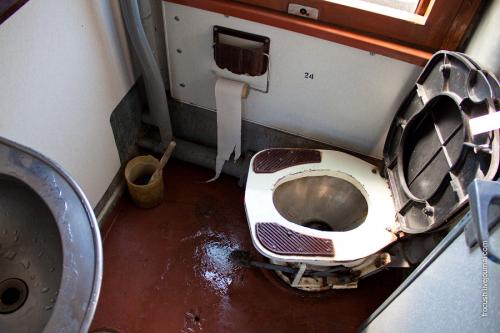
Toilets & Showers: There are two toilets at each end of each carriage with a WC and a sink. In better trains the toilets are quite clean, but most of the

Trans-Siberian train toilet
A standard train toilet
time they are quite dirty. So, it's better to have cleaning materials (such as face wipes, etc.) with you.
There are no showers (showers are provided in every compartment only in the 1st class, train #3 and #4, and in a separate carriage in some trains for extra payment - about 30 R ($1)).
The compartments are being regularly washed, and vacuum-cleaned, so they tend to be tidy (but that is on "good" trains only - see Trains section).
Food in Trains: There are always restaurants in Russian trains, but the quality of the food and high prices keep people away. However, almost on every station local people sell inexpensive and nice home-made food, so you won't be hungry. Maybe it only worths taking some specific things, like muesli and milk for breakfast.
Also, a conductor sells some snacks and drinks for not expensive.
Money: Payments on board of the train are made in local currency only. Normally, you may be able to change US dollars in the train (conductor will do it or will find a dealer for you), but the rates are very low. So, it's better to have some local currency (Russia - roubles, China - yuans, Mongolia - tugriks) and the whole sum in US dollars. Dollars are very easy to exchange in Russia, Mongolia or China.


Tips & Safety:
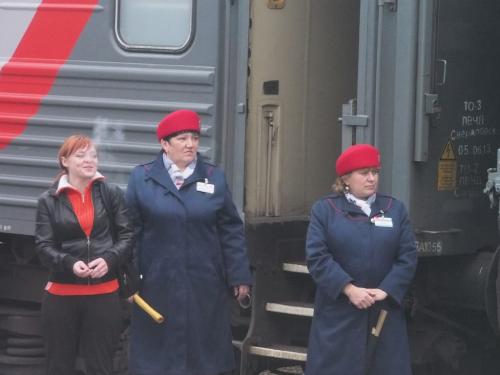
Basically trains in Russia are more secure than the streets of the cities. There are few people around and they have no chance to disappear. Just behave yourself normal (unless you're after some adventures) and it'll be ok. There are militsioners (policemen) at most of the trains. So if you have problems ask conductor to call them. If there are no policemen on the train, they will enter on the next station. If it's the conductor who pisses you off, go to the train-master ("na`chalnik `poezda"), he's usually in his compartment, carriage #0.
It's a long way and it might be boring sometimes. The journey from Moscow to Beijing lasts for 6 days. Of course there's a beautiful view from the window sometimes, but there will be moments when you might be very bored. Your compartment mates might save you with vodka and zakuska, but also try to be prepared: take a book, something to write, music or something else to have things to do.
Probably, the best remedy against the boredom is to hop off along the way.
Be careful hopping off and on. The trains along Trans Siberian stop only for 5 to 20 minutes. If you decide to go outside, be careful: you may hear the hiss and the train might start leaving. They say they don't wait for passengers.
Food and water. There’s a restaurant in the train, which serves more or less good food at usually high prices for the quality it is.

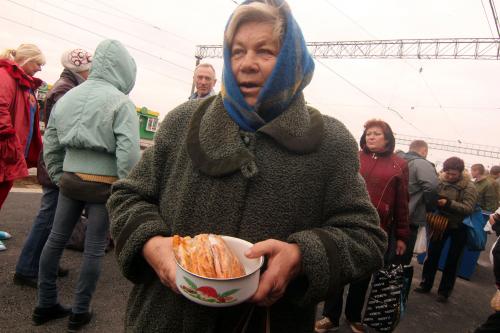
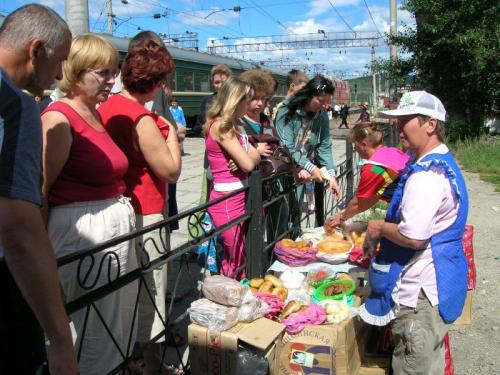
Women selling food outside Trans-Siberian train (by Celina Smith)
Women selling food outside the train
Russian people usually bring with them some food, and buy some at the stops. What they traditionally bring is hard-boiled eggs, salted cucumbers, bread, dried cakes such as ‘Suckaris’, and sausage ‘colbasa’. On the stops they buy boiled potatoes, more eggs, cakes, beer, vodka, dried noodles, fresh or salted fish, and fresh vegetables such as home grown tomatoes, cucumbers. Many old Babushkas living in the cities where the Trans-siberian train stops prepare fresh food before each halt. It’s a nice business for them, and what they prepare is often very tasty. For example they make all kind of ‘Pirozhki’ e.g. cakes filled in with cottage cheese or meat, or vegetables, or fish.
Tea is a traditional Trans-Siberian train beverage. There is a special cup, specific for the train: a glass slipped inside a metallic holder with a hand. One can ask a tea to the provodnik, who will fill up this special cup with hot water and drop inside a tea bag. The nice thing is to ask for the tea once and then to keep the cup and drink your own tea inside it. The hot water provided in the train is free, and as it is boiling it shouldn’t be dangerous to drink it.
The food that is sold on the stations by locals is just great, delicious, and very cheap. You can buy everything: from a bottle of beer or water to home made potatoes, chicken breast, or smoked fish from Baikal lake. So, it's not necessary to stock any food with you, maybe only some things you won't find along the way, like muesli and milk. In the Trans-Siberian Route section of this
Trans Siberian train tea boiler
Trans - Siberian train tea boiler
guide, we list the stations, where you can find the best food on the Trans Siberian.
Usually, a meal bought from people outside costs about 30-50R ($1-$2).
Every Trans-Siberian train has a special tea-boiler, that works on fire! It is a very nice thing, and you can have hot water for free, or make yourself some tea (teabags can be bought from conductor very cheap).
Also, conductor usually sells some snacks (chips, chocolate bars) and soft drinks (water, cola, beers).
Hygiene: If you take a second class place, you'll have no shower. It means that in 6-day travel from Moscow to Beijing (or from Beijing to Moscow) you'll have no chance to wash yourself. There are toilettes (with sinks) at every car.
We recommend you to take some soft wet "baby's" pads with you (sold in any pharmacy), and liquid soap. The toilet and bathroom in the train is likely to be not clean, so you will need things like this to wash yourself.
The towels are given with bedsheets.
Take a personal first aid set with you. There's only one in the train, the train-master has it (his compartment is usually in the #0 carriage just after the conductor's one). Doctors are available only at the stations.
Do not drink much alcohol and keep an eye on what are you drinking. I saw on some messageboards people saying how much they liked to drink traditional Russian drinks - vodka, for instance - while traveling in Trans-Siberian train. Well, be careful, the vodka might be not good quality and robbers like to put a soporific (to make you sleep) in tea or vodka or something.
Russian and Chinese dealers on the train. These trains are popular among Russian and Chinese dealers. They take all their commodities (cheap clothes, food etc.) and pack the trucks with it. So during short stops in Russian towns the stations seem more like markets. The only way not to ride with them is to take the 1st class.
Do not keep your money in one place. And read money safety tips at Practicalities / Money section. Keep most of your money, documents and your tickets always with you. It's more secure and in a case you will be left behind by the train you'll be able to do something about it.
There are ATMs and banks to cash travelers' cheques in the big Russian cities along the way, but there are problems with ATMs and banks in Mongolia, so be careful.
Keep your luggage under your bed. If you have a bed on top, it's better to keep luggage at the overhead storage area, and fasten it with a chain or a rope to any metal construction (there are plenty of them and 1 meter rope is enough), so robbers can not steal it fast and silently in the night.
If there are any serious problems cry: "Pozhar!" (Fire!), so that most of the people will come to you for the sake of saving their own life.
Always tell the truth to the customs officers about the amount of cash you have (if you have more then you are allowed, you will just give some to the officer and no problems, but if they find more then you have told, they can even take you off of the train). So again, if you have lots of money, it's better to carry them on a credit card or in travelers' cheques, that way there'll be less problems. But remember, it's hard to find ATMs in Mongolia.


Hop On / Hop Off the Train:
Really, the best way to travel along the Trans-Siberian, is to hop off the train a few times. In the Introduction section we list the places (in Russia) we think it is interesting to visit.
However, there's one little problem. Standard train tickets in Russia (including the Trans-Siberian) are not open — you will have a specific date and train that you should travel. So, if you would like to hop off along the way, you will have to either plan everything beforehand, or buy tickets as you go. But there's a danger (especially during high season) that there won't be any tickets left.
There is a way around it: some agencies (including the one that proposes services on our site - Services / Train Tickets) sell a special kind of train tickets, which allow you to hop off any place along a certain route. And then, after reserving another part of the journey, hop on the next train (and so on, as many times as you wish).
To illustrate, say, you want to go from Moscow to Beijing, and you know you want to stop in Novosibirsk for sure, but then, you don't know for how long you want to stop there, or if you will
Bridge over Amur river
Bridge over Amur river -- longest bridge of TransSib - © MPS (Russian Railways Ministry)
stop anywhere else afterwards. Then you book the whole journey Moscow - Beijing, and also claim you will stop in Novosibirsk for sure, but then want to be free about how long you'll spend there, and about your next train, and about where you will stop next. You will buy the ticket Moscow - Beijing, with the route Moscow - Novosibirsk paid completely, the rest of the route (Novosibirsk - Beijing) will be paid half price. When you stop in Novosibirsk, and spend enough time there, you will need to come to the railway station, show them your ticket (with Novosibirsk - Beijing paid half price), and tell them you want to take a specific train going on a specific date from Novosibirsk to a certain destination (Irkutsk, for example). You will need to pay extra on top of your ticket (in this case, about $30), and will have another part of your ticket paid completely (the part Novosibirsk - Irkutsk, that is). After you arrive to Irkutsk, you enjoy there, and when you are sure about your plans, go to the railway station again, and buy the other part of the route. Finally, when you reach Beijing, you will have used your ticket. Before you reach the final destination, always keep all tickets you bought with you — don't throw them out.
Again, you can get this type of tickets through agencies only (not at a railway station), and the agency we work with can provide you these tickets (we used their services ourselves Summer 2002 and were very satisfied).
To book your ticket, you can go to Services / Train Tickets.
 

Your Comments & Questions:
If you have something to say (or ask) and you want it to be posted on this page, please, leave your message below. We will put on this page the most interesting comments and questions.
You can also leave a message in the Trans-Siberian section of our Talk Lounge forum.

Your message:
Post it here? Yes                No


Question (posted 14/03/03): "hello
I would like to know the price for a transsibàrian train ticket in july for exemple for a young person that is to say 20 ,from moscow to irkuskt. And if that was possible too the price of a return by plane between Irkuskt and moscow?
Thank you very much if you can answer to this message before tonight.Anyway thank you."
Answer: A ticket from Moscow to Irkutsk should cost about $130 US (2nd class, coupe). There are no discounts for young people. I really don't know how much the price will be in July, but it shouldn't be more than 10%. A plane ticket is about $130 one way as well.

Question (posted 2/04/03):
"my question is. I wouild like to know if it would be possible to make stop offs at various destinations from Moscow to bejing. would i have to make it clear my stop offs beforehand, is there anything like an open ticket?"
Answer: Yes, it is possible. You have two options:
(1) Buy all tickets by yourself in every new city you stop. This may involve queues and waiting (the tickets will most likely not be available for the same or next day.
(2) Book an "open ticket" through a travel agency. With this ticket you need to come in every new city, confirm your place, and pay a fee, which is normally less than the ticket price. In this case you have priority and there's more chances. See Services / Train Tickets to reserve a Trans-Siberian tickets.

Question (16/01/04): "Hello,
I want to go to mongolia by motorbike (small one, old mz).
Is it possible to use the transsiberian for some hundred kilometres to transport me AND the motorbike? If so, what would it cost (let`s say Kazan' Novosibirsk?"
Answer: This may be possible, but only with a post train. In any case, it will be hard to arrange it in a "proper" way, and you will need to talk directly to the railroad officials and ask them for a favor maybe.
One good idea could be to directly to the director of the railway station you're taking the train from ("nachalnik vokzala" in Russian) and ask him how it would be possible to put your bike on the train and how much it would cost. I think it is realistic to have it travel with you for something like twice the price of your own ticket.

Question (20/01/04): "hi!I?m thinking about travelling alone in transiberian this coming summer.is it very dangerous?
thanks!!"
Answer: It's not dangerous, not at all. I travel there every summer, and never ever had a slightest problem!

Question (5/02/04): "I am looking to travel from Moscow and finish in Hong Kong. How much should I expect to pay for such a ticket, and how long would it take?
Secondly, are there power points in the cabins?"
Answer: I think it's going to cost you not less than $350 US for one way Moscow - Beijing, and then Beijing - Hong-Kong would be about $200.


Comments, Questions, Feedback?


0
No votes yet
Your rating: None

Practical Advices for Trans-Siberian Travelers > Most Recent


Russia Travel Black List

During more than 10 years that Way to Russia is online we know the local travel market quite well. So we created this Russian travel blacklist to make...


Russian Tourist Visa Support Application

A Russian visa support document (also known as invitation) is needed in order to get a Russian visa. The tourist visa support is comprised of a...


Group Tourist Visa Support Application

If you are traveling in a group (2 and more people), have the same itinerary, and will apply at the same consulate you can apply for a group...